How to Identify Search Intent With ChatGPT (SEO Guide)

You can identify search intent with ChatGPT by asking it to classify keywords based on what a person is trying to accomplish, then using that intent to decide what kind of article or page should exist before you write anything.
Search intent matters because people search with different goals at different moments. If your article does not match that goal, it will struggle to rank, engage readers, or generate leads no matter how clear or well written it is.
Why identifying search intent matters for creating articles
Most content fails not because it is poorly written, but because it answers the wrong question. Search intent helps you understand what a person expects to see when they click on a result, which makes it easier to create content that feels immediately relevant.
When intent is mismatched, readers leave quickly. When intent is matched, people stay longer, trust the content more, and are more likely to take the next step whether that is reading another article or contacting a business.
How search intent works using a real travel example

Imagine you are planning a short trip to Rome. You use Google multiple times during the planning process, but each search reflects a different goal even though the destination stays the same.
When you search “what to see in Rome in 3 days”, your intent is to learn. You are gathering ideas and building a mental picture of the trip. The right page here is a guide or itinerary that explains options and provides context.
Later, you search “best areas to stay in Rome”. Your mindset has changed. Now you are trying to compare neighborhoods and decide where to stay. You expect explanations, advantages and disadvantages, and practical recommendations.
Finally, you search “book hotel near Trevi Fountain”. At this point, you want to act. You are looking for prices, availability, and a clear way to complete a booking. An educational article at this stage would clearly be inappropriate.
Nothing about Rome changed. What changed was your intent. Search engines try to recognize this shift and rank pages that best match what the searcher wants at that moment.
Search intent categories explained with everyday examples
Most searches fall into a small set of practical intent categories. Keeping these simple makes them easier to apply consistently.
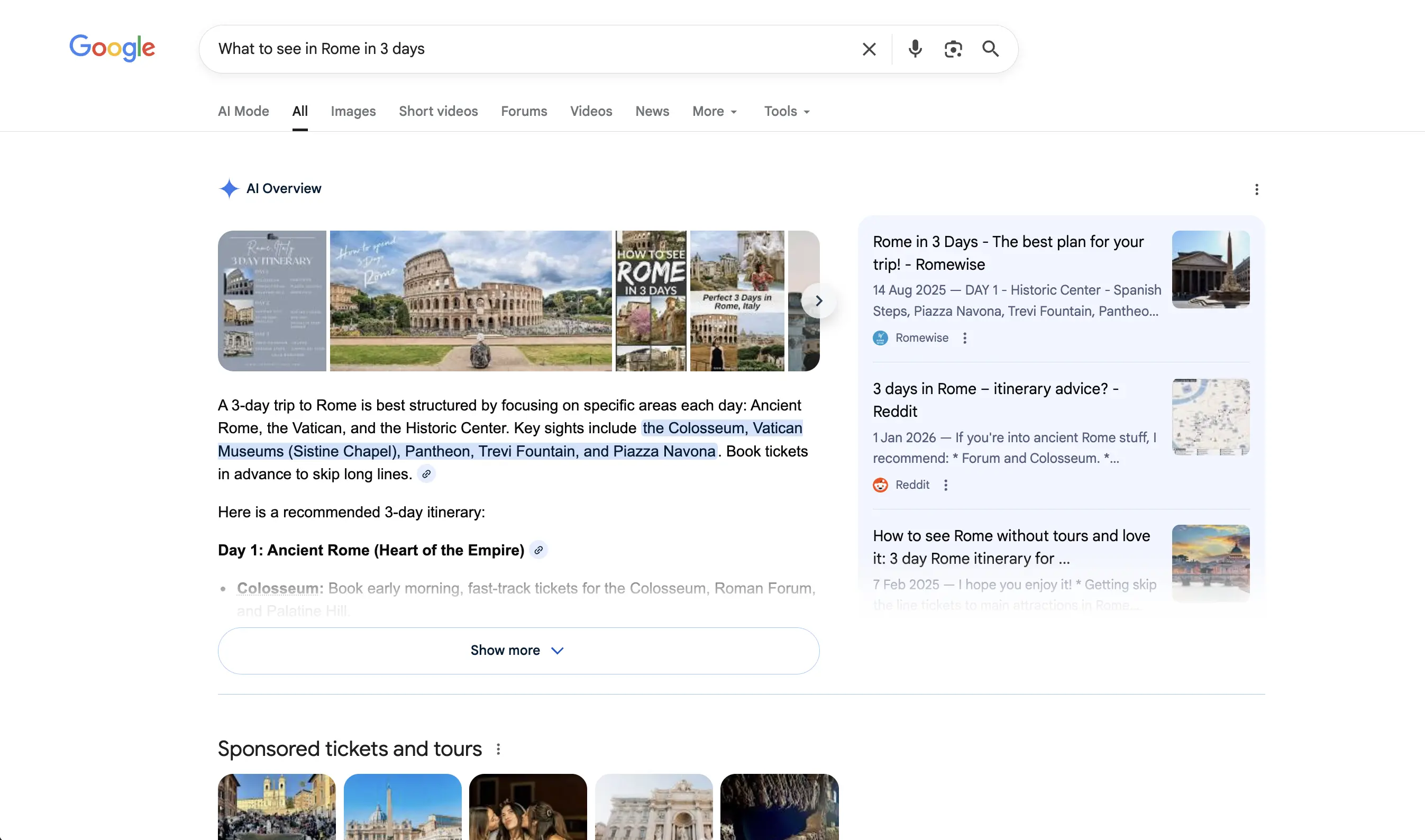
Informational intent means the person wants to understand or learn.
- “What to see in Rome in 3 days”
- “Is Rome expensive for tourists”
- “Best time of year to visit Rome”
These searches call for guides, explanations, and helpful context. The goal is clarity, not persuasion.
Commercial investigation intent means the person is comparing or evaluating options.
- “Best areas to stay in Rome”
- “Rome hotels vs Airbnb”
- “Is staying near Trevi Fountain worth it”
Here, the reader wants help deciding. Articles should focus on comparisons, trade-offs, and practical advice.
Transactional intent means the person wants to take action now.
- “Book hotel near Trevi Fountain”
- “Rome airport transfer price”
- “Buy Colosseum tickets online”
These searches are best served by booking pages, service pages, or clear calls to action not long blog posts.
Understanding these differences helps you avoid writing content that feels misaligned with the reader’s expectations.
How search intent helps you plan new articles

Search intent turns content planning into a structured process instead of guesswork. Instead of sitting in front of a blank page asking, “What topics should I write about?”, you start asking a much more practical question: “What decisions or questions does my audience have at each stage of their journey?”
This shift immediately reduces friction. You are no longer inventing ideas you are mapping real human needs to specific types of pages.
When you plan content through the lens of intent, you stop thinking in isolated articles and start thinking in content roles. Each article exists to do one job well, rather than trying to do everything at once.
One topic can naturally produce multiple articles when viewed through an intent lens. For example, a single travel destination can support:
- Informational guides for early planning, such as understanding the destination, timing, or basic logistics.
- Comparison articles for decision-making, such as choosing neighborhoods, accommodations, or transportation options.
- Transactional pages for bookings, where the goal is to help someone complete an action quickly and confidently.
These pages are related, but they are not interchangeable. Each serves a different moment in the reader’s decision process.
This approach also prevents content overlap. Without intent, it is common to write several articles that all partially answer the same question, which leads to confusion for both readers and search engines. With intent, each article has a defined scope and a clear reason to exist.
From a planning perspective, this makes your content easier to organize. You can group articles by intent, see gaps more clearly, and prioritize what to create next. For example, you may realize you have plenty of informational content but very little that helps readers compare options or take action.
Most importantly, intent-based planning makes your content more useful. Readers feel understood because the page they land on matches what they were actually looking for. That alignment builds trust, keeps people engaged longer, and naturally guides them toward the next step whether that is reading another article or becoming a lead.
Using ChatGPT to label search intent correctly

ChatGPT can help speed up intent identification by quickly classifying keywords based on wording and structure. You can ask it to label each keyword as informational, comparison-focused, or transactional.
For example, given a list of travel-related searches, ChatGPT can group learning-oriented queries separately from booking-oriented ones in seconds. This is especially helpful when working with large keyword lists.
Going back to our example, imagine you provide ChatGPT with the following keywords and prompt:
- “what to see in Rome in 3 days”
- “best areas to stay in Rome”
- “book hotel near Trevi Fountain”
Prompt:
- “Classify each keyword by search intent using only these categories: informational, comparison-focused, or transactional. Return the result as a simple list.”
ChatGPT would typically label the first as informational, the second as comparison-focused, and the third as transactional. This makes it immediately clear that these searches require different types of pages, even though they all relate to the same destination.
However, ChatGPT should be treated as a starting point, not the final authority. It does not see live search results and cannot fully understand your audience or business context. A short manual review ensures the intent label actually matches what a real person would expect.
Common questions and edge cases
How does search intent analysis help me as a beginner?
Search intent analysis for beginners removes uncertainty when creating content. Instead of guessing what to write, you focus on what the searcher wants to accomplish. This makes article creation more focused and less overwhelming.
How can I classify keywords by intent without SEO tools?
You can classify keywords by intent without SEO tools by reading the query and asking what action the person expects to take next. ChatGPT can help label keywords quickly, but reviewing ambiguous cases manually is always recommended.
What to do next
Before writing your next article, pause and identify the search intent behind the main keyword. Decide what type of page should exist, then write with that purpose clearly in mind. When content matches intent, it becomes easier to rank, easier to read, and more effective at generating results.