How To Use AI to Create Product Comparison Tables That Make Buying Easier - A Headphone Example

You can use AI to create headphone comparison tables by feeding it trusted product specs, telling it which features matter to your audience, and having it output a clean, consistent table format, then verifying the numbers and adding buying recommendations.
If your goal is a fast, readable headphone spec comparison that helps people decide, AI product comparison tables can save hours of manual formatting while keeping feature names and units consistent across models.
Why AI-made headphone comparison tables make buying decisions easier
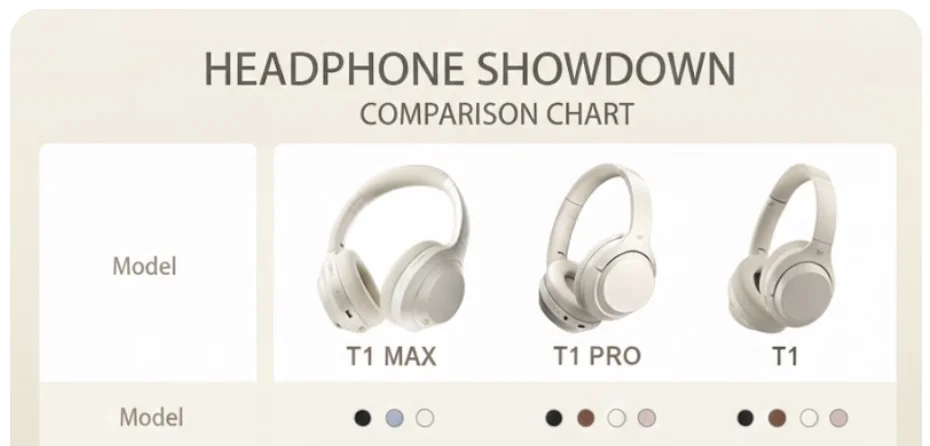
Most people do not struggle to find headphone options. They struggle to compare them. One listing highlights battery life, another focuses on noise canceling, and a third buries codec support in a PDF. A table fixes that, but building one by hand is tedious and easy to mess up.
Using AI to create headphone comparison tables helps in three practical ways:
First, it standardizes language. Instead of mixing terms like "ANC," "active noise cancelation," and "noise cancelling," your table can use one label and keep it consistent.
Second, it reduces decision fatigue. When readers can scan a single headphone buying guide table and see "Multipoint: Yes" or "Latency mode: Yes," they stop bouncing between tabs.
Third, it makes updates simple. If a brand releases a new version with longer battery life or adds a new feature, you don´t have to rebuild the whole table by hand. You just update the new numbers in your list and let AI regenerate the comparison table in minutes.
This matters most for common shopping situations: choosing wireless headphones for commuting, picking a headset for calls, or deciding whether spending more actually buys better microphones and comfort.
How AI turns product specs into a clean headphone buying guide table
At a high level, AI works best here as a structuring tool. You provide the facts, and the AI helps you normalize, compare, and present them.
A practical process looks like this:
1. Collect specs from sources you trust. Manufacturer pages, official manuals, and reputable measurement sites are better than marketplaces where listings are often wrong.
2. Convert those specs into a single consistent dataset. This is where AI helps most. It can extract fields, rename them, align units, and spot missing values you need to fill.
3. Decide your comparison schema before you generate the table. For example, choose 10 to 18 fields that match the buyer intent:
- For commuters: Noise canceling quality notes, wind reduction, transparency mode, battery, quick charge.
- For office calls: mic type, call noise reduction, sidetone, multipoint, mute controls.
- For gamers: latency mode, wired option, dongle support, mic monitoring.
4. Generate the table in your site format. Ask for Markdown, HTML, or CSV. Markdown is convenient for review posts and many content management systems like WordPress.
5. Verify every row against the original sources. AI can misread units, confuse "up to" claims, or assume features that vary by region.
If you want a simple starting point, keep one table for specs and a second short table for "best for" recommendations. The table does the scanning, and the recommendation helps the final decision.
AI product comparison tables that readers can actually trust

The main risk with AI product comparison tables isn’t how they look, it’s accuracy. A table can appear clear and professional even if one detail is wrong.
To keep readers’ trust, build your table with clear rules and always link each key spec back to a reliable source.
Use consistent units and definitions. Examples that commonly break comparisons:
- Battery life: "with noise canceling" vs "without noise canceling" should be separate columns or clearly labeled.
- Bluetooth version: do not imply range or latency improvements automatically.
- Codecs: confirm device support varies by region and phone brand.
- Driver size: larger does not guarantee better sound, so keep it informational.
Include "Unknown" instead of guessing. If you do not have mic frequency response or weight with ear pads, leave it blank and note it.
Add a short footnote style note under the table in your article body, such as "Specs compiled from manufacturer pages as of [month]." You can also keep a private source log, even if you do not publish all links in the table itself.
If you run a review site, consider separating claims into two layers:
- Layer 1: manufacturer specs (battery, weight, codecs, IP rating).
- Layer 2: test results (noise canceling performance, mic quality, comfort notes).
AI can help merge those layers into one table, but you should label which fields are measured vs claimed.
AI-assisted review site building: practical workflow and common mistakes
AI-assisted review site building works best when you think in systems: a repeatable intake, a clean database, and a consistent table template.
A practical workflow:
- Create a master spreadsheet with one row per headphone model.
- Define your columns once. Examples: Price, Type, Weight, ANC, Transparency, Battery ANC On, Battery ANC Off, Charge Port, Quick Charge, Multipoint, Codec List, App, EQ, Water Resistance, Warranty.
- For each new model, paste raw specs into a "Notes" column.
- Use AI to transform the Notes into the exact columns you use, with strict formatting rules.
Common mistakes to avoid:

- Mixing generations and variants. "XM5" vs "XM5 (International)" vs "XM5 (Refurb)" can silently change included accessories or warranty.
- Treating "up to" as a typical result. Battery "up to 40 hours" may be at low volume without ANC.
- Collapsing different connection types into one field. "Wireless" can mean Bluetooth, 2.4 GHz dongle, or both.
- Overloading the table. If the table has 30 columns, readers stop scanning. Keep it focused and add a second table if needed.
- Skipping the human pass. AI is good at structure, but you still need to catch obvious buyer facing issues like "no ear detection" or "no wired mode."
If you are building a larger site, you can generate tables per category from the same dataset: "Best for calls," "Best for workouts," "Best budget noise canceling headphones." The key is that the underlying data stays consistent, and only the filters change.
Common questions and edge cases
How to generate headphone comparison tables from product specs using AI?
Start with a clean list of sources and a fixed amount of columns, then prompt the AI to map each model’s specs into those columns without inventing missing values.
In practice, you get better results if you provide:
- The exact columns you want, in order.
- Allowed values for tricky fields (for example noise canceling: None, Basic, Advanced).
- Unit rules (grams for weight, hours for battery).
You can then ask the AI to output Markdown tables for your article and a CSV version for your database. Always spot check at least 3 to 5 fields per model against the original pages, especially battery with noise canceling.
What is the best prompt to create a headphone feature comparison chart for a review site?
A strong prompt is specific about input, output, and validation rules, and it tells the AI to avoid assumptions.
Use something like this, then paste your specs under it:
"Create a headphone feature comparison chart in Markdown. Use these columns in this exact order: Model, Price, Type (over ear, on ear, in ear), Weight (g), ANC (Yes or No), Transparency (Yes or No), Battery with ANC (hours), Battery without ANC (hours), Multipoint (Yes or No), Codecs, App (Yes or No), Water resistance (IP rating or None), Wired mode (Yes or No), Notes. Rules: Do not guess. If a value is not explicitly stated, write Unknown. Keep units consistent. Do not add models I did not provide. After the table, list any inconsistencies or missing fields you found."
This applies especially well when you want a consistent headphone spec comparison across many posts.
What to do next
AI can format and standardize headphone specs into a clear comparison table quickly, but the best results come from a fixed column schema and careful verification.
Next step: pick 5 to 10 columns your audience actually cares about, gather specs for 5 to 10 headphone models from reliable sources, and use one strict prompt to generate your first table in Markdown, then manually confirm the key fields before publishing.